
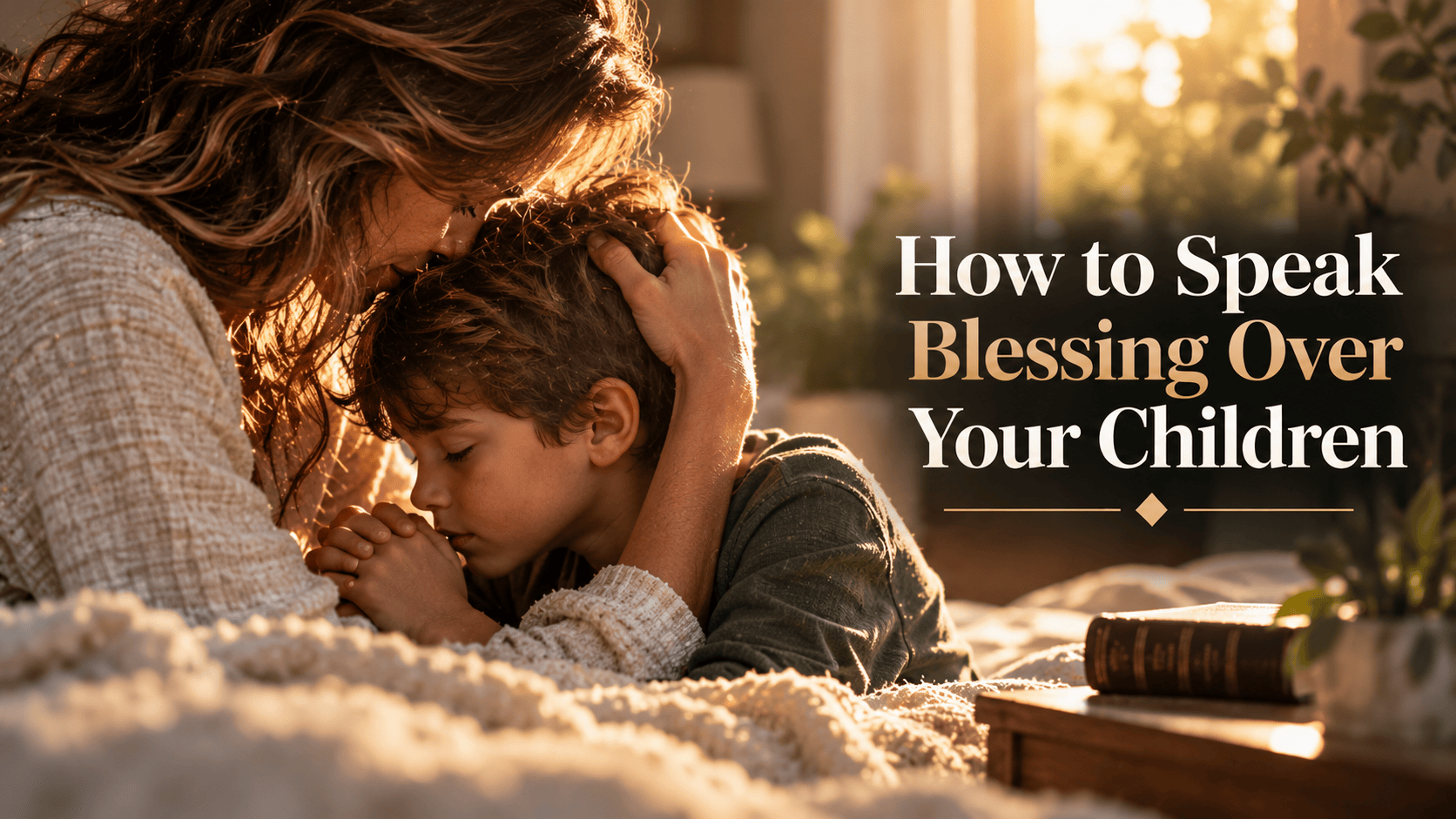
What intentional things do you say over your children to help them feel loved? I want you to take that question seriously. If you do not know the answer, begin writing some things down. Practice if you need to. Your children need to hear what they mean to you.
I have talked with many men who told me their fathers never said they loved them. You can hear the emptiness when they talk about it. They wanted to hear those words, and they never did.
Do not assume your family knows everything you feel. Tell them. Speak life into the people God has entrusted to your care. I want to show you four parts of a family blessing: meaningful touch, a spoken message, an expression of value, and hope for the future.
Give affection along with your words
Genesis 27:26–29 records Isaac asking his son to come near and kiss him before he speaks a blessing. Notice the affection and the words together. There is a meaningful touch, and there is a spoken message.
Your children need both. Let your affection express the love you are speaking. Make time to be near them and to give them your attention.
Blessing should be something a child can hear and experience. We need to be intentional about expressing love in our homes.
Let your children hear your encouragement
One of my favorite gifts to operate in is encouragement. I know what it is like to have it, and I know what it is like to go without it. When someone speaks encouragement into my life, I feel stronger.
That is what we can give our children. Encouragement gives courage. Discouragement takes courage away. Our words can strengthen the people around us, and we need to use them that way.
Think about the Father speaking over Jesus. At His baptism and at the transfiguration, the Father identifies Him as His beloved Son and expresses His pleasure in Him (Matthew 3:17; 17:5). I see an example there of openly expressed love.
Tell your children you love them. Tell them you are proud of them, and mean it. Let them know you believe in them. This matters in marriage and friendship too. Every meaningful relationship needs words that strengthen it.
Make room for your voice at the family table
If you are not speaking into your children, who is? Their friends, teachers, coaches, and the voices on their phones are all speaking into their lives. Your voice needs to be a steady source of love and direction.
One of the best places to make that happen is the family table. I remember looking forward to family meals, the conversation, and the laughter. We need to recover that time intentionally.
Put the phones aside. When you are together, be together. Look at the people across the table and talk with them. Give your family the attention that so many other things are competing to take.
A shared meal gives you time to listen, encourage, and remind your children that they matter to you.
Recognize the value of each child
Every child is different. Find what your child is good at, celebrate it, and speak into that part of his or her life.
A child who does not enjoy sports may love music. There is nothing wrong with that. Your child does not have to share all your interests or become a copy of another family member.
In Genesis 49, Jacob speaks distinct words over his sons. Judah is described as a lion, and Joseph as a fruitful vine. I draw a practical lesson from those individual word pictures: pay attention to the person you are blessing.
Learn your child’s gifts. Recognize what makes that child different. Let your words communicate value, so your child knows you see something worth encouraging.
Speak hope over their future
You do not have to be a prophet to encourage your child toward a good future. Speaking a blessing does not always mean predicting something God must make happen. It can mean expressing what you see in your child and encouraging that child toward the right path.
When you see a gift, help your child see the possibility of growing in it. Speak about that future with hope. Do not repeatedly label a child as worthless or incapable and then expect those words to strengthen that child.
I get passionate about this because I am tired of watching people tear one another down. Our families need to come together and begin strengthening one another.
Start with the opportunities already in front of you. Express affection. Give a sincere word of encouragement. Notice a gift. Make time for conversation. Let your children hear that they are loved and that you see a future worth encouraging.